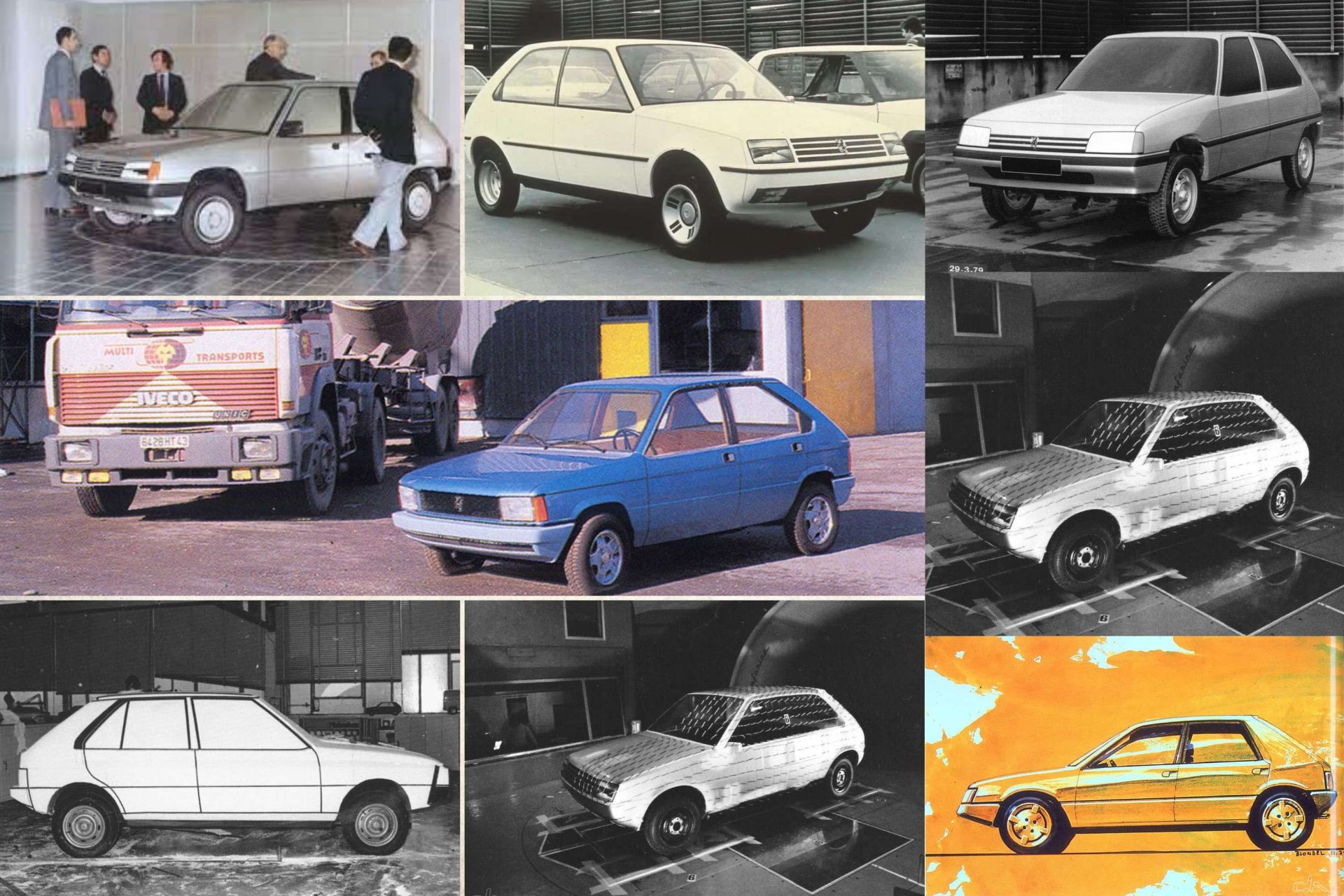
In 1978, Chrysler Europe's subsidiaries were acquired by the newly formed PSA Group, which was established following the rescue of Citroën in 1976. Peugeot has big plans to become the European GM by acquiring the brands Simca, Rootes, and Barreiros. This vision would quickly give way to disillusionment due to structural and cyclical problems. The 1979 oil crisis once again shook an industry that had only just recovered from the first crisis of 1973. The newly formed group struggled to organize and structure all its industrial operations. The model lines of the various manufacturers were becoming outdated, and the newly acquired brands had no new projects in the pipeline. The merger of these new entities under the Talbot name in 1979 confused consumers. The group was in dire straits with more than 2 billion francs in losses in 1981, and market share that fell to an all-time low in 1982, at just 12.7% for Peugeot and 5.3% for Talbot. An alarming situation that will be resolved at the last minute by a model that achieved unexpected success, the Peugeot 205. . A look back at its history.

The long gestation of the Peugeot 205
In 1977, the small- and midsize car segment was dominated by the 104, which had enjoyed a respectable run since 1972 (Read "50 Years of the 104: The Little One" Peugeot bares its fangs). A well-established model that can't compete with the brazen success of the Renault R5, which has a wide-open road ahead of it (Read: 50 Years of the R5—It's Still Going Strong). The Peugeot 104 is too serious and too small. At the top levels of the automaker, they began considering replacing the 104 with the M24 Project. The broad outlines of the specifications were set: the wheelbase would be identical to that of the 104, but the car would be wider. The 5-door and 3-door versions would have the same dimensions, and the 3-door model would need to have a distinct identity. The weight was not to exceed 800 kg. The broad outlines were in place, even though they would evolve throughout the development process, which officially began on July 12, 1978. The project already had a name—it would not be the “105,” as the press was still reporting in 1981, but rather Peugeot 205. A figure that was intended and championed throughout the development process by Jean Boillot, a senior executive at Peugeot who rose through the ranks from member of the executive board in 1976 to chief executive officer in 1979, before becoming chairman of Automobiles Peugeot in 1984. This choice was no accident and signaled a break with the past. The 200 series has always played an innovative role in the history of Peugeot. The 201 introduced the three-digit model numbering system with a zero in the middle and was the first car with independent front suspension, No. 202 has benefited from extensive aerodynamic research, the Peugeot 203 has relaunched Peugeot at the end of World War II and the Peugeot 204 was revolutionary as it was the brand's first front-wheel-drive model. The News Peugeot must be revolutionary in its own way.
A hallmark of a well-designed product, the main features of the sketch of the future Peugeot 205 were already established as early as 1978 by the head of design at the time, a certain Gérard Welter. Without realizing it, he had just sketched out the most important project of his life. A single stroke of the pencil that resembled the model presented by Pininfarina, a longtime partner in design Peugeot, will not be selected during the comparison on January 5, 1980. A design that has evolved slightly to match the new dimensions that were chosen. In 1980, market statistics showed that the B1 segment for small cars (2CV and R4) was losing momentum, while the B2 segment—where the R5 competed (between 3.50 and 3.70m), is booming, accounting for more than 40% of new car registrations in France. In the export market, the upper M1 (4m) segment—where the Golf and the Opel Kadett are positioned—is very significant. A model in between will be selected as the final choice; it will be 3.80m.
Inside, it's the proposal by the famous Paul Bracq which is chosen for its modern design and its easily interchangeable instrument cluster for right-hand-drive markets.


The Revolution of the Peugeot 205
In research and innovation, lThe designers will draw on the elements selected from the Vera concept, released in 1981, to make it a car firmly rooted in its time. This concept meets new requirements for fuel efficiency as well as passive safety, with reduced weight and a carefully optimized drag coefficient. The design elements of the future 205 are already evident. The distinctive bumper design, the low grille with rubber-sealed gaps, and the flush windows are all features carried over from the Peugeot 205.
Weight Reduction was also crucial with the adoption, on the 205, of the rear suspension with horizontal shock absorbers from the Vera concept. Computer-aided design, which had made its tentative debut in 1972 at Peugeot, has become a key element in the car's design. This technology reduces the body weight by 26 kg compared to the 104, while providing greater rigidity thanks to a 40% reduction in the number of weld points and the use of high-yield-strength steel.

The model is finally ready for a long series of reliability testing at the Belchamp Technical Center in the Doubs region. One anecdote illustrates the scope of the testing. The new locks, which can be operated with a single key—a first—feature a metal latch that closes when the key is removed, preventing the lock from freezing. This is handy during these freezing temperatures to avoid reenacting a certain scene from *Les Bronzés font du ski*! To test this system, more than 100,000 test cycles were conducted under the most extreme conditions.
Even though a few photos had been leaked to the press, no one could have imagined the sensation the 205 would cause. As early as 1982, customers were able to get a glimpse of the new strategy for Peugeot along with the more prestigious 305 Series 2, which proclaimed, “A manufacturer shows its true colors.” Every effort is being made to leave a lasting impression. On January 20, 1983, the 205 was unveiled to dealers in Monaco. It was met with unanimous acclaim when the curtain was raised. The car began reaching potential customers as the first 150 units were delivered to dealerships for test drives. On February 21, the press published the first test drives, before the 205 officially went on sale on February 24. At launch, only the 5-door version—the high-volume model—was offered in seven different configurations, divided into five trim levels and three engine options. These featured the X engines from Française des Mécaniques, which were also used in the 104. Three engine displacements were offered, ranging from 954 cm³ to 1,360 cm³, including a 1,124 cm³ option, with power outputs ranging from 54 to 80 ch.
Understated, high-performance, comfortable, and with exemplary handling, The press is full of praise. The car quickly won over customers, and within a few months it was already a success, capturing 5% of the French market.
Stay tuned for Part 2 to revisit all the versions that have contributed to his career's success. ;)


 English
 Français