Shopping Cart
 Français
 English
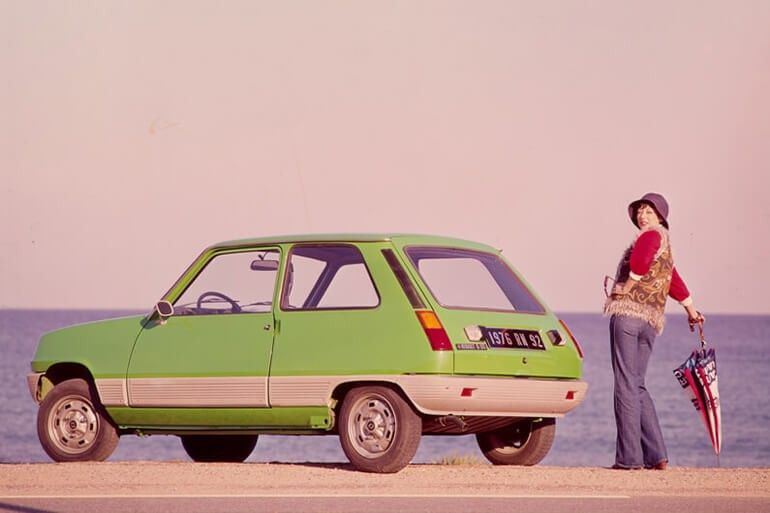
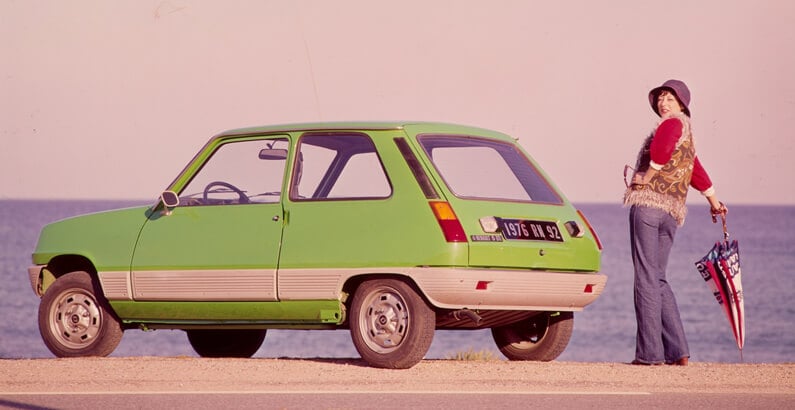
In 1968, within the premises of Boulogne-Billancourt, the idea of a new car emerged. Pierre Dreyfus, then CEO of Renault, sensed there was a new market for a small car as sturdy as the rustic 2CV and R4 but with a more elegant line and unparalleled versatility. Project 122 was born and resulted, on January 28, 1972, in the presentation of the Renault 5. A true revolution loomed with a blend never seen before in such a small car. A sleek design equipped as standard with the first deformable plastic bumpers (reinforced polyester), a hatchback extending down to the bumper, and two large doors with concealed handles. A successful design by Michel Boué that entered the seventies with its flashy orange, light green, and red colors. Put on your flared pants, play your 45 rpm record "Le Lundi au soleil" by Claude François, and settle comfortably on your Formica chair; it's time for the story of the R5!
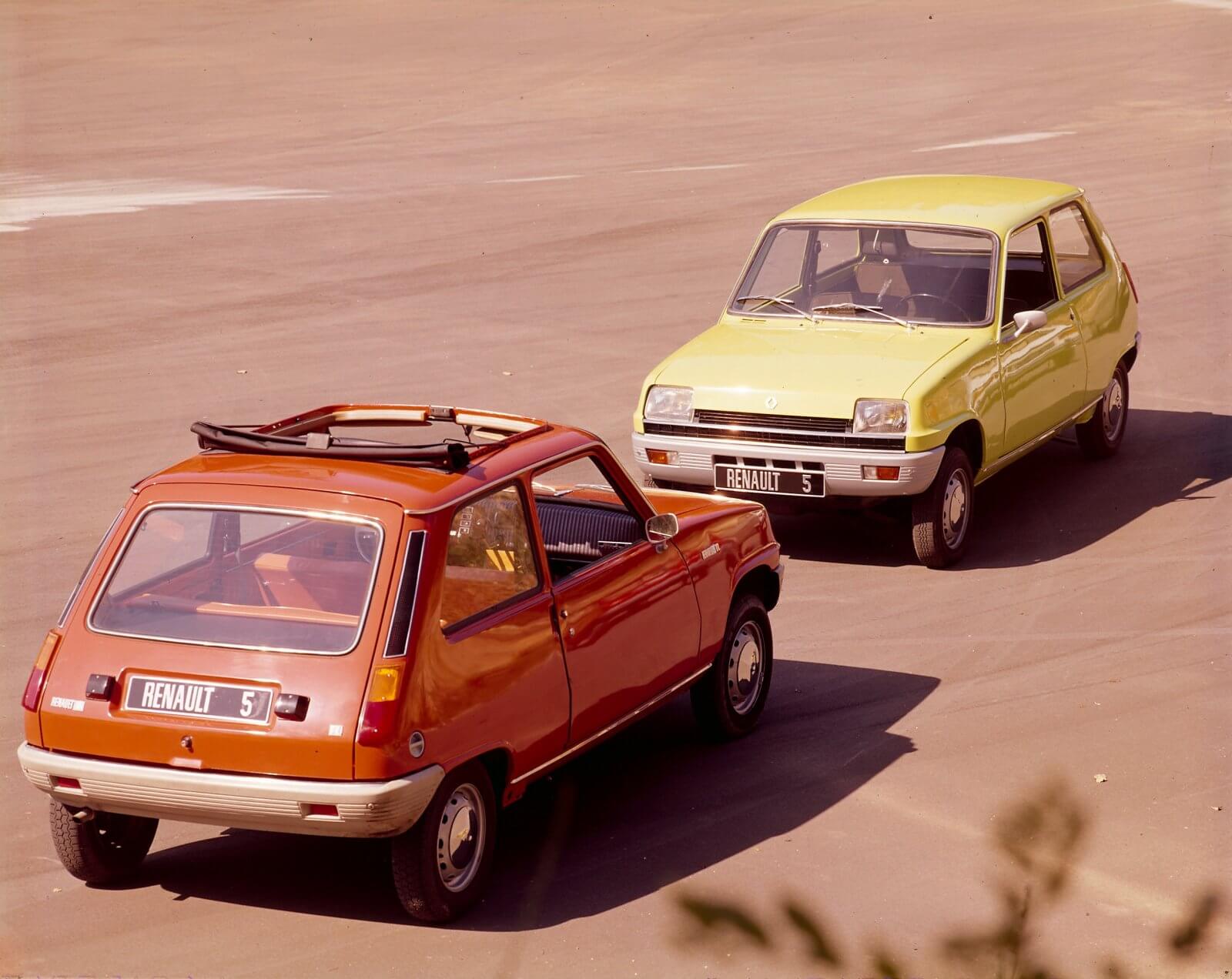
The R5 surprises with its versatility, allowing it to easily weave through both the streets of large cities and the provincial roads. All with excellent space for its size and innovative practical features like the foldable rear seat, allowing the trunk volume to expand from 270 dm3 to 900 dm3. Handy for packing all your things when your ex leaves you.
Attractive, economical, practical, and efficient, the Renault R5 was in high demand across France, becoming the country's best-selling car between 1974 and 1983.

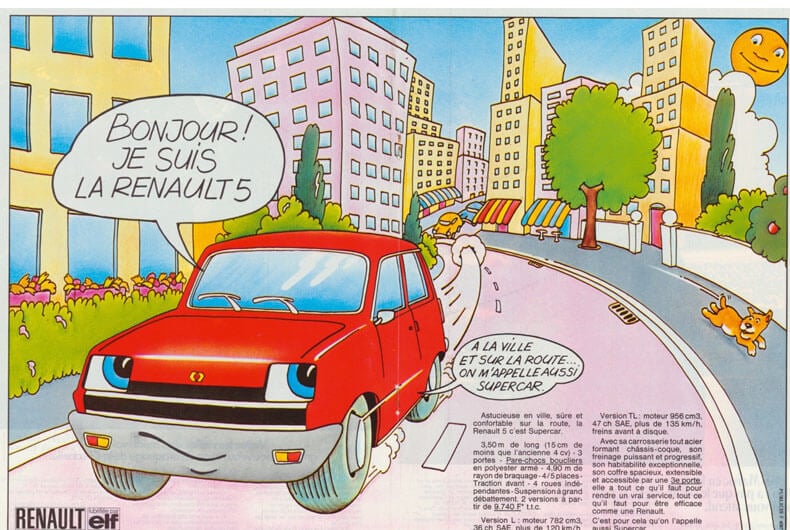
This success is also explained by a quirky advertising campaign for its time. The R5 was personified as an endearing comic strip character, with headlights shaped like eyes and a mouth in the bumper. Advertising brochures, promotional films followed the adventures of this new comic strip hero who became the best daily ally of the French, affected by the first oil crisis. The communication didn’t stop there, with Renault R5s circulating in major cities with stickers reading "I am the Renault 5, take my wheel." A simple hand gesture, like hailing a taxi, and you could drive away for a test. It was easier than stopping a Parisian taxi...
Renault had foresight and knew how to sustain its success by listening to its customers. The gear lever, R4 type on the dashboard, not sporty enough? The option with floor control came out in 1973. Need more practicality? The 5-door version was released in 1979. Want to move more easily in the city? An automatic gearbox was offered in 1978. Need an elevated R5 to climb city curbs, the Captur came out in... Ah, I digress, that wasn't the same era!
The R5 ventured to travel and landed in North America under the name LeCar in 1976. The meeting to choose the name must have been quite lively... It met with some success, notably in Quebec, where it was imported until 1986. A car that pleases everywhere it stops.

While its road qualities were praised, it lacked more powerful models compared to the modest L (36hp) and TL (47hp) versions. In 1976, an Alpine version was introduced with the "Cléon-Fonte" engine, 1397 cm3 with 93 hp, allowing it to reach over 175 km/h. A GTI ahead of its time, further shaping the image of the R5.

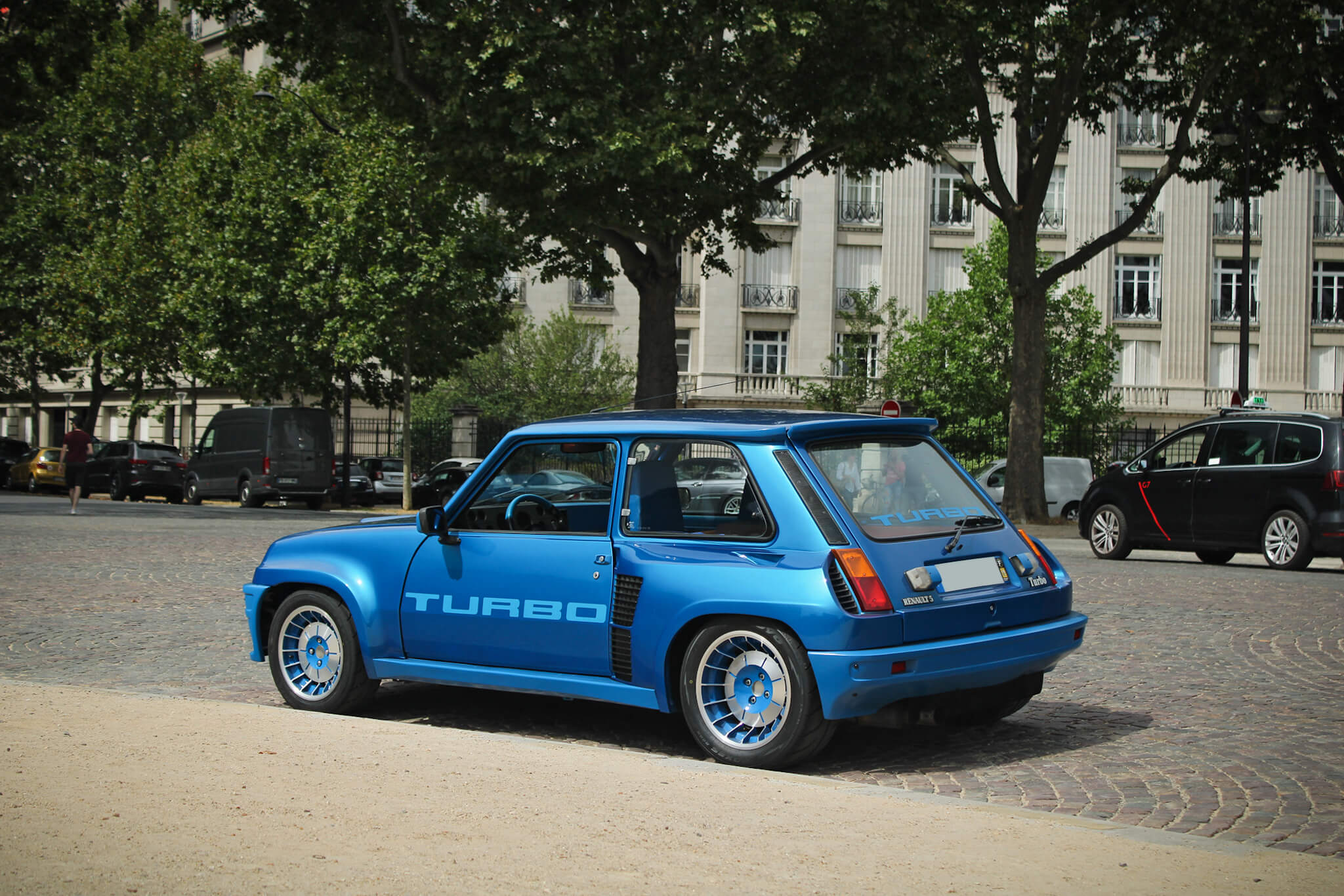
The sporting pedigree of the R5 reached its peak in 1980 when Renault unveiled the final version of the R5 Turbo. As a result of the homologation conditions to enter the FIA Group 3 and Group 4 competitions, the Turbo retained only a few parts from the standard model to achieve a weight of only 970 kg. An R5 body was taken from the assembly line to be sent to Heuliez to receive the rear chassis section. Then, the assembly was sent to Dieppe, to the Alpine-Renault factory to receive the engine and the rest of the bodywork. A true UFO that swaps its front-wheel-drive architecture with a transverse engine for a rear mid-engine, rear-wheel-drive layout. The 1972 R5 is far in the rearview mirror, very far indeed..., with its incredible performance (160 hp, 210 Nm, and 6.9s from 0 to 100 km/h) coming from the R5 Alpine engine, to which a Garrett turbo was added and the fluid circulation was revised. During its presentation, the Alpine version also evolved into a turbocharged version, but with a more modest technical specification (110 hp, 152 Nm, 9.1s from 0 to 100 km/h).

The Turbo astonishes and clinches numerous victories in the hands of, among others, Ragnotti, Saby, and Chatriot. Notable wins include the French Rally Championship in 1981, 1982, and 1984, and the Monte Carlo Rally in 1981. Not bad, not bad.
A model that brilliantly concluded the end of the R5’s career and still fascinates today. The exclusive Turbo versions with aluminum openings and interior signed by Bertone are the most sought after.
With the R5, Renault achieved one of the biggest French successes, totaling 5,580,000 units. A car that has marked many generations and will continue to leave its mark on the future with its electric reinterpretation. In the meantime, to preserve your beautiful “5”, ALÉPOC offers numerous spare part references for maintenance and restoration.
Happy Birthday Renault 5!