Ah, the 1960s, a decade of carefreeness in a thriving society where technological progress knows no bounds. We inhale, exhale, and envision a bright future emerging in the 1970s. This same mindset is shared by the leaders of our car manufacturers. The automotive market is growing, and the increase in wealth allows for the prospect of higher-end cars with greater engine capacity. The American Dream is also enticing, and French manufacturers, already established for some years, no longer want to play a minor role. The decision is made, it is necessary to a noble engine! Problem, the manufacturers are still independent and it is too risky to undertake the development of such an engine alone. Very quickly, Peugeot and Renault will come closer while Simca continues with its American V8s and that Citroën buys Maserati to use its V6. Peugeot and Renault will be joined by Volvo who also sees it as an opportunity to replace its 6-cylinder gasoline engine. That's what's needed to move the Viking Drakkars!
An ambitious engine
The Franco-Swedish company PRV Engines was thus born on June 28, 1971. The Française de Mécanique site in Douvrin was chosen to manufacture the future PRV engine. This site is also the result of an agreement between Peugeot and Renault which will, in particular, produce the X engine for the Peugeot 104 (read: 50 years of the Peugeot 104, the little one Peugeot shows its fangsThe "Z" project comes to life with the intention of having a modular engine offered in both V8 (ZO) and V6 (ZM) configurations with the same architecture. The specifications are approved. The angle will be 90° with cylinders of 444 cm³ (bore of 88 mm and stroke of 73 mm), resulting in a V6 of 2,664 cm³ and a V8 of 3,552 cm³. The V6 is scheduled to be released in 1974 and the V8 in 1976..
The construction aims to be modern with a block and cylinder heads made of aluminum alloy, ensuring a lighter weight and therefore better road handling as well as reduced fuel consumption.
The project is enticing on paper, the dream of a strong comeback for French manufacturers in the high-end segment is about to come true, but everything collapses in the fall of 1973. The first oil shock, linked to economic and geopolitical factors, quadruples the price of a barrel of oil and marks the end of the thirty glorious years. The time is no longer for celebration, but rather for saving, with speed limits appearing everywhere.
The V8 is leaving.
The fuel-hungry engines are relegated to the background and the V8 PRV will never be released. in series. Only the V6 in the final phase of development will be released in 1974 on the Volvo 264 and the Peugeot 504 Coupe (read Peugeot 504 coupé: the commoner in an evening dressThe first version of a long series delivers 125 hp and 207 Nm (136 hp for the 504) thanks to its three twin-barrel carburetors.
The engine is smooth and pleasant to drive in cruising mode, but it suffers from a shaky ignition due to the90° opening which favored the V8 architecture. On the V6, it was not deemed important to adjust the crankpins to achieve a regular cycle. This was a common choice at the time for modular engines but gave a negative first impression of the PRV. This offset produces a distinctive sound and does not allow for easy revving. The comparison is harsh against the wonderful 6-cylinder engines produced by BMW and Alfa Romeo. End of the story? Not really, the PRV engine has managed to evolve in many versions throughout its career to address some of its flaws.

A V6 with multiple faces
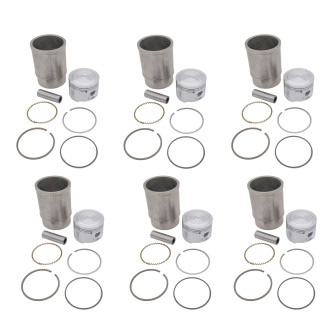
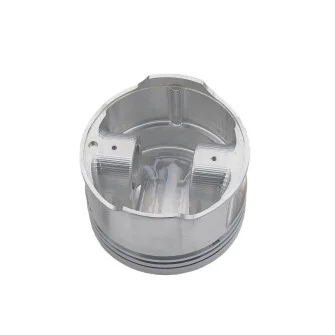
In 1975, the redesigned exhaust line allowed for a gain of a few horsepower (131 hp) on the engines installed in the Renault R30 and Peugeot 604. Forgotten grand touring cars that deserve to be saved. For this, we have a Shirts and pistons set of high quality.
Mechanical parts
Out-of-Stock
The rather excessive consumption (almost 30 L per 100 km) during dynamic use makes its operation costly in times of crisis. The adoption of injection was confirmed in 1977 with the K-Jetronic injection on the 604 Ti and the R30 Tx in 1978.
Carburetors are putting up resistance – oh those Gauls – with a final version featuring a dual triple-barrel carburetor producing 165 hp, mounted on the Talbot Tagora. Given the success of the model, it is difficult to find one these days.

In 1980, a major development occurred with the increase of the bore to 91 mm, producing a displacement of 2,849 cm³. The first derivatives did not benefit from a significant power increase, as it was offered in a 130 hp and 216 Nm version on the Volvo 260 and the legendary DeLorean DMC-12. These performances were sufficient to reach 88 miles per hour and activate the time converter...
A new base that will give a new lease of life to the Franco-Swedish V6. In 1984, Peugeot only has the word GTI in mind and equips its luxurious 604 sedan with a GTI version featuring the 2.8 V6 engine with 155 hp and 238 Nm.
In parallel, Renault which rides on the success of its R25 introduced in 1983 releases in 1985 a unreleased R25 V6 Turbo. Turbocharging allows the PRV V6 to be thoroughly revised to reduce the displacement to 2,458 cm3. The injection and ignition are managed by a Renix system and Renault Take advantage of these changes to finally resolve the ignition issue with a crankshaft with offset crankpins. The performance (182 hp and 276 Nm) and the sound are finally up to par. A nice birthday gift for the engine's 10th anniversary.
On its side, the 2.8-liter version continues its journey with a rectified ignition and Renix injection at Renault. It is available with a catalyst (153 hp) or without a catalyst on the R25 phase 2, then the Espace II.
In Sochaux, confidence is placed in the Bosch LH-Jetronic injection system for the 505 V6, which reaches 205 km/h with 170 hp and 235 Nm of torque.
The last major evolution of the PRV occurred in 1989 with an increased displacement for the final time. The main evolution of the 2975 cc engine lies in the option to have it with 2 valves producing 170 hp and 235 Nm, or an innovative 4-valve version for PSA with 200 hp and 260 Nm.
The Volvo 960 marks the end of an era for Volvo in 1991 as it focuses on developing its new 5 and 6-cylinder gasoline engines.
In 1993, the final version appeared with a slight reduction in displacement to 2,963 cm³.

The PRV is unintentionally athletic.
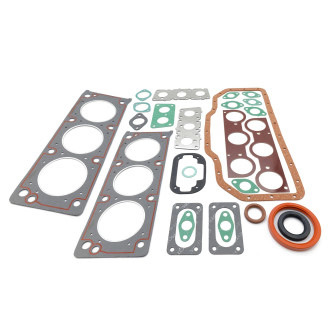
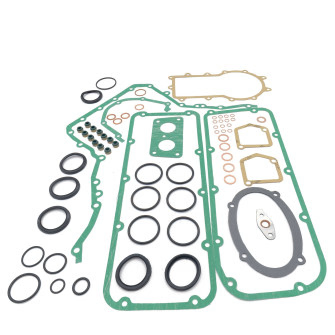
At launch, the PRV was not known for being very sporty, but its excellent reliability led it to be placed under the hood of sports cars to deliver top-notch performance. Moreover, to ensure this reliability, we offer you a Complete gasket set for PRV maintenance. On the road, it's the entirety of the Alpine V6 who were entitled to this engine, from theA310 to A610. This latest one will offer up to 250 hp and 350 Nm of torque. Thrilling!
Always on the side of Renault, the scandalous Safrane Biturbo there will be a version revised by Hartge with a 12-valve configuration and 268 hp for a top speed of 250 km/h!
Our French Ferrari also received the honors of the PRV. Initially, the Venturi was supposed to adopt a simple 4-cylinder engine of Peugeot 505 but the road tests were not conclusive, which led the designers to adopt the V6, which turned out to be the right choice. It will peak at 408 hp and 520 Nm in a 24-valve version under the hood of the Venturi GT. The 125 hp of the first version are far in the rearview mirror.

In the paddocks, the PRV ran under the hood of numerous prototypes from the French team WM, which was created in 1969 by two designers from Peugeot: Gérard Walter and Michel Meunier. The V6 was able to resonate in the Sarthe on numerous occasions and in different versions between the 70s and 80s. The pinnacle occurred in 1988 with the P88 that broke the speed record In the Hunaudières straight. 407 km/h! A record that will surely never be surpassed with the installation of the chicanes. Peugeot will willingly reduce the speed reached to 405 km/h to align with the marketing of its new 405 sedan. Fortunately, the 106 hadn't been born yet... Under its extremely sleek bodywork, there is a heavily modified 2,974 cc PRV V6 engine with two Garrett turbos, producing 910 hp!
The PRV enjoys Le Mans and endurance racing and found itself under the hood of racing Venturis with a maximum power of 650 hp on the latest version named 600 SLM. A beautiful racing machine that sealed the fate of the brand...
Finally, the V6 PRV will bite the dust in the Paris-Dakar with the 4x4 UMM Alter and the Peugeot P4 assistance of Peugeot Sport and Citroën Sport. He will go into battle under the armor of the Panhard VCR and ERC 90. Finally, he will take off by equipping the prototype with the Robin R 3000/01, a 100% French airplane.
In 1998, theEspace III definitively concludes the story of the PRV V6. after 24 years of a rich and exciting life. Initially criticized, it will ultimately be a success as a reliable, durable, and high-performance engine. Thanks to its compactness with a 90% opening angle and its lightness, it could be adapted to many cars in longitudinal, transverse, or central positions. It will be replaced by the new V6 ESL jointly manufactured by Renault and Peugeot after 970,315 units produced.



 English
 Français