Shopping Cart
 English
 Français
French cars in Italy: strong connections
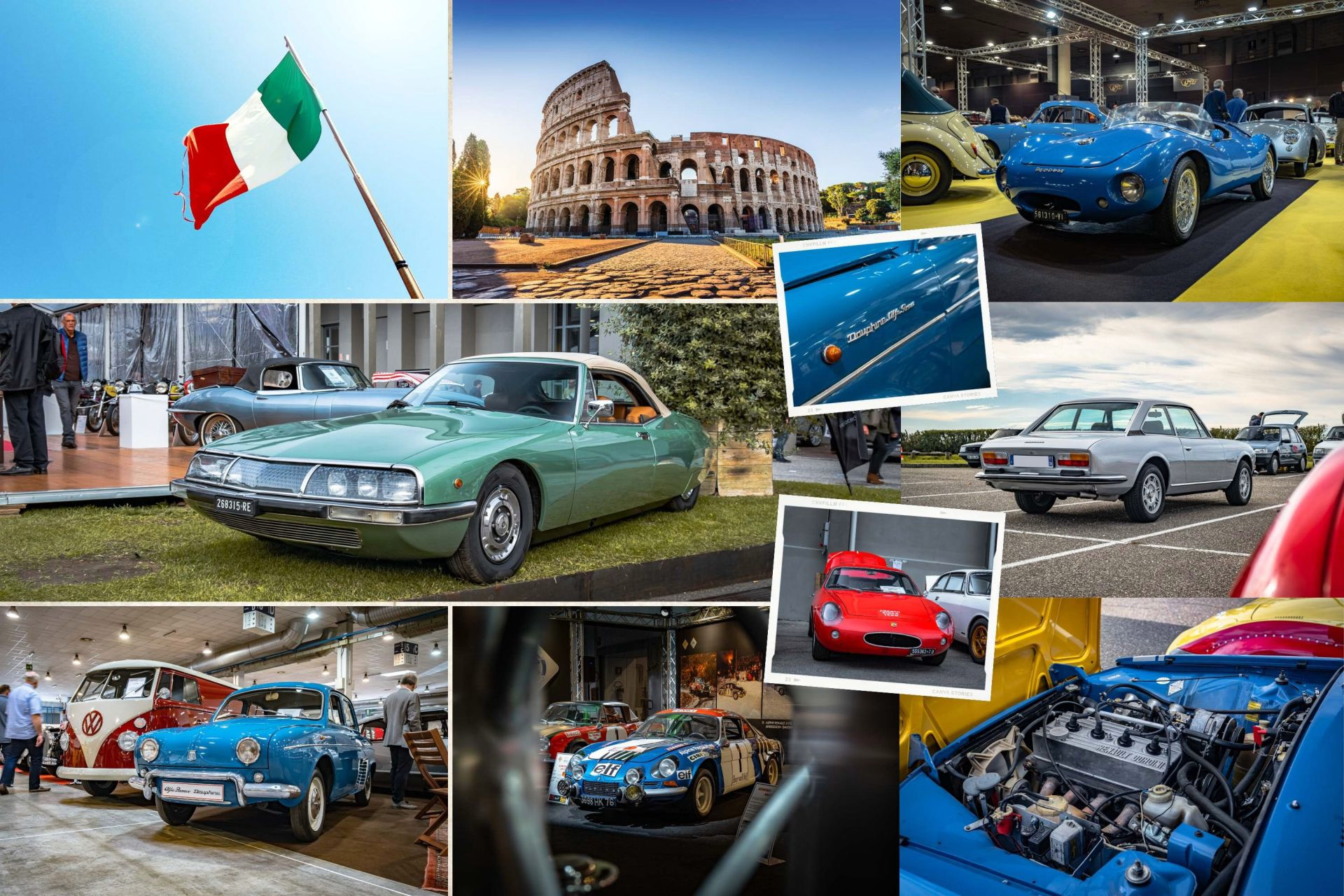
France and Italy are among the nations that participated in the rise of the automobile in the world and contributed to its progress thanks to a culture of motorsport. Two nations with different destinies that nonetheless cultivate, in their own way, a certain passion for automobiles. Strong ties that have occasionally influenced our French manufacturers. Let me offer you an overview of these French cars with an Italian flair: mama mia!
Simca, the French-Italian manufacturer
Simca It is undoubtedly the French manufacturer with the most Italian influence since it is none other than Fiat's subsidiary in France. To avoid heavy import tariffs, Fiat decided, in light of the success of its models, to manufacture them directly on the territory. On November 2, 1934, the company was established. "Industrial Society of Mechanical and Automotive Bodywork", a 100% French company in which Fiat is concealed. The first models will therefore be Fiat-badged models. Simca-Fiat. The Simca 5 is a perfect example, being a Fiat Topolino with the logo. Simca. Very quickly, the logo will evolve to eliminate the mention of Fiat, but it was not until 1951 that the first car appeared that was not just a simple rebadging. Although sharing the same techniques (self-supporting body), the Simca 9th Arrondissementis different from the Fiat 1400. It still has a Fiat engine, and the models that will follow will continue to be either Fiat projects or Ford projects with the acquisition of Ford SAF in 1954. The last car sold under the name Simca, the 1100 will find its counterpart at Autobianchi with the Primula.
Fiat gradually withdrew by selling the majority of its shares to Chrysler in 1962, as the new common market allowed the manufacturer to create a new subsidiary and directly import its own models into France.
Within the range, some models will have an even more Italian connotation, such as the AbarthSimca born from a cooperation agreement between Simca and the Fiat tuner in Italy. TheAbarthSimca 1300 GT, a course version based on the Simca 1000, but equipped with an Abarth engine and design. It is also the first major project for the tuner, who is more accustomed to light modifications. At Alepoc, we had the chance to get close to one of these specimens during the Auto e Moto Epoca show in 2022.
Finally, the last very Italian variation, the Simca 1000 coupé by Bertone designed by the famous Giorgetto Giugiaro. Another Italian!
Discover our pieces Simca

Pininfarina, the Italian style
A French brand greatly shaped by Italy, but other major manufacturers have all had some Italian influence. In Sochaux, the lion fell in love with the Italian divas and established a great collaboration with Pininfarina for the design of its cars. An important collaboration that will give birth to numerous models. 403 and 403 convertible, the entire 404 family, the PEUGEOT 504 coupe and 504 convertible and even the 205 convertible and 406 coupe (read Peugeot 504 coupé: the commoner in an evening dressAccording to the coachbuilder, it was their second largest collaboration after Ferrari, no less!
By the way, speaking of Ferrari, did you know that the Commendatore loved to get around by Peugeot ? It seems astonishing when one has at hand the machines of all fantasies, but in a recent interview with Enzo Ferrari's private chauffeur (Dino Tagliazucchi), we learn that he only had a Ferrari 365 GTB in his garage, which he used for certain commercial promotions. The rest of the time, Enzo loved to get around in a Peugeot 404. His driver remembers transporting him in some Peugeot 504 sedan 504 coupe until Fiat, the new shareholder, pressured to use models from the group. This incongruous love is due to good publicity by his friend Giovanni-Battista Farina, who praised the dynamic qualities of the Peugeot. A fruitful collaboration indeed! Finally, as the great competitor he was, Enzo wanted his car to start the fastest at the traffic light. He had found this quality in the Peugeot, which contemporary Fiats did not have. A man of taste!
It is even rumored that the first real four-wheeled car to have driven in Italy was a Peugeot Type 3 in 1893!
Discover our spare parts Peugeot

The incongruous marriage of Citroën and Maserati
The other great national pride, which I have named Citroën, was also greatly influenced by Italian craftsmanship. Just like Peugeot, the revolutionary lines of the Citroën mythical are due to a very well-known Italian designer, Flaminio Bertoni. They are not only good at making pizza! Citroën Traction Avantt, 2CV, Citroën DS or even Citroën Friend 6 come from his drawing board.
Citroën also had close relations with Italian manufacturers, notably Fiat, which acquired a stake in its capital in 1968 and eventually held nearly 25% of the company by the early 1970s. A decade that almost saw our flagship company fall under the Italian flag during its bankruptcy in 1974, but we all know the story: the state blocked the process to prevent the industry from moving abroad and Peugeot was forced to absorb Citroën.
Of course, we could not fail to mention the acquisition of Maserati by Citroën in 1968 which led to the creation of the fabulous Super Maserati, with a Maserati V6 engine. A car equipped with the best of both manufacturers. The innovation and comfort of Citroën with Italian mechanical nobility. A wonderful car that will be a failure due to the oil crisis and its reliability.
Discover our pieces Citroën

Renault and Alfa Romeo, a story under tension
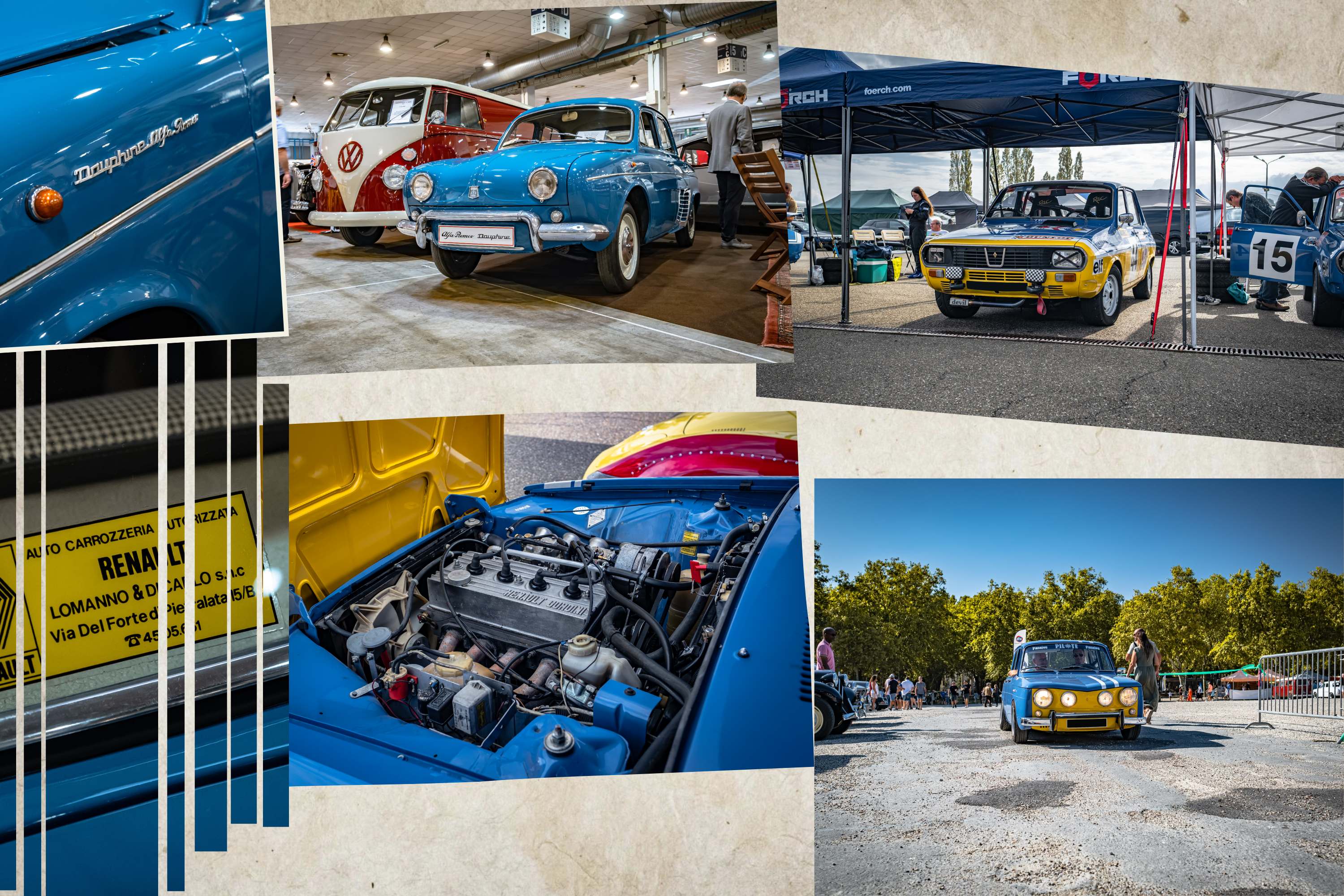
On the management side Renault, the Italian venture takes the form of a bilateral agreement with Alfa Romeo for the licensed production and distribution in Italy of the Renault Dauphine. An agreement born from a desire, for the Italian manufacturer specializing in sports cars, to cover the small car market without costly investments in order to compete with Fiat's hegemony. Renault on his side wishes to expand in Europe, but is facing still significant customs duties, even though the treaty establishing the ECSC marks a step in building a common market. In 1959, The Alfa Romeo Dauphine comes out of the Portello factory near Milan. The model is essentially the same with a few homologation details. We had the chance to see an example at the last Padua show. A little over 73,000 units (including 2,000 Alfa Romeo Ondine) would come off the assembly lines in almost 7 years, but the project was not a resounding success due to numerous tensions between the two brands. Alfa Romeo accused Renault to block the evolution of the model to meet customer needs. Also Renault would not have respected the terms of the contract by offering the Dauphine for sale in its Italian network and never distributing the Giulietta in return.
We cannot mention Renault without mentioning the "wizard" Gordini. This mechanical enthusiast built his reputation by tuning racing engines. He first operated at Simca with the Simca 5 Gordini, which won the 24 Hours of Le Mans in its category in 1937 and broke the lap record at the Montlhéry racetrack in 48 hours. Starting in 1951, Gordini became independent and undertook numerous projects, particularly in F1, before working in 1957 for Renault, on the engine of the Renault Dauphine Gordini. This project will be followed by the most illustrious of its projects, the R8 Gordini which allowed many drivers to make a name for themselves through the R8 Gordini Cup. A source of pride for this man from the racing world who sees his name being acquired by Renault in 1969. Other projects will be released before his death, including the R12 and R17 Gordini.
Discover our spare parts Renault
Italian motorsport
Italy being a sporting land, it was not uncommon to come across models from our national manufacturers. The race of the Mille Miglia could see, between 1927 and 1957, races of Citroën Traction 11B and 15 Six as well as DS19. At Peugeot, these are the Peugeot 203 and 403 who participated in this legendary race. At Renault, the story is a bit more striking with the participation of the Renault Dauphine and 4CV. The 4CV actually won first place in its category for the 1952 edition in the hands of Pons and a certain Rédélé. The multiple successes in competition with the 4CV germinated in Rédélé's mind his project for a lighter and more sporty car. The first Alpine was born from this desire with a body designed by the Italian (yet another one) Michelotti and powered by the mechanics of the 4CV. To promote his new model, Rédélé entered it in numerous races, including the Mille Miglia in 1956, which resulted in a class victory. The Alpine legend was created.


Our French builders have all had close relationships with Italian culture. very influenced by automobile racing and a taste for style. Nations that were bound to cross paths sooner or later, eventually merging recently to create the Stellantis group. Ultimately, Citroën finds Maserati and is part of the same group as Fiat. History is always full of surprises!
Published on
15-04-2023