
Shopping Cart
 English
 Français
Are the bearings of vintage cars made of babbitt?
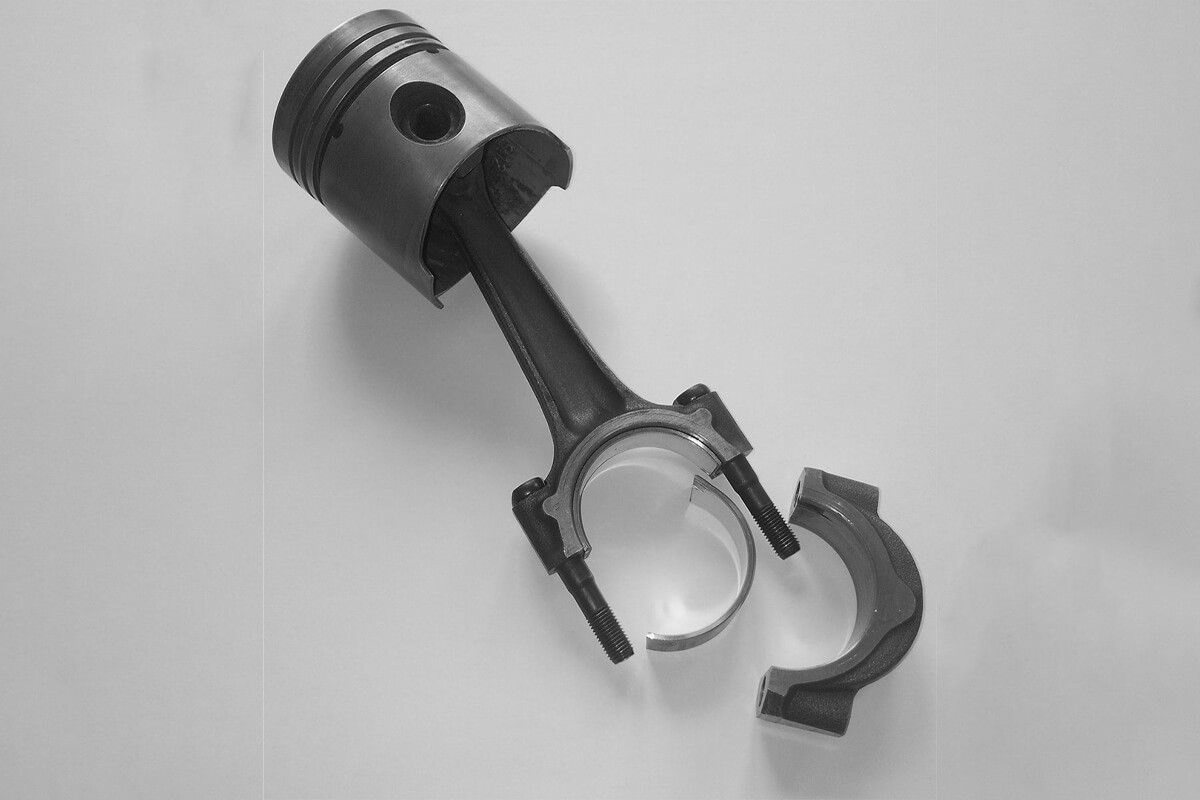
Among all the engine parts for vintage cars that we offer on the Alepoc online store, there are bearings. And a question that comes to mind is that of babbitt metal. Are the bearings in vintage cars made of babbitt metal? We tell you everything!
Babbitt metal, bearings, what are they for?
Let's place ourselves in the engine of your vintage car, at the level of the crank assembly. The connecting rods rotate on the crankshaft, on the crankpins, while the crankshaft rotates on its bearings that connect it to the block. To ensure everything runs smoothly, plain bearings are used. In fact, it's a specific material that allows metal to rotate on metal, with obviously a film of oil between the two. To avoid major problems when the oil film is not perfectly formed (in case of oil shortage or during startup, for example), the crankshaft metal must be very hard, and the plain bearing metal must be much softer, in an alloy called an anti-friction metal. This is the role of babbitt metal and bearings. In any case, this is the scenario most often found in vintage car engines.

What is babbitt metal?
At the beginning of automotive history, a metal alloy called babbitt metal was used as the anti-friction metal. Developed by Isaac Babbitt, it is composed of tin, copper, lead, and antimony. It's a very soft alloy that melts and doesn't weld. This is the primary property of an anti-friction alloy.
Initially, babbitt metal was applied directly to the parts. A layer was placed in the bore of the connecting rod, and the bearings were coated with it.
Babbitt metal has another advantage: it is easy to work with. It melts at a relatively low temperature and machines well. Thus, many mechanics at the beginning of the 20th century repaired the babbitt metal themselves when a connecting rod failed. Sometimes the help of a grinder was needed to machine the crankshaft if it was too damaged.
And what about the bearings?
In the 1930s, automotive engine technology was refined. Gradually, it was realized that time could be saved, both in manufacturing and maintenance, by changing the process. Babbitt metal was no longer applied directly to the connecting rod or bearing but to a metal shell inserted into the bore. This is the bearing. It became widespread and the most used solution after World War II.
As mentioned, bearings started being created (not necessarily thin, look at the bearings of a traction) with babbitt metal as the anti-friction metal. Later, as crankshafts became harder due to advancements in metallurgy, a harder alloy that would melt less quickly could be used: red metal. The alloy then consisted of copper alloyed with lead.

Progress did not stop there. Subsequently, layers of lead were added to the bearings by electrolytic deposition. And the base alloy evolved further. Rather than red metal, they returned to another white metal, this time composed of aluminum alloyed with tin. It's a bit less robust but still better than babbitt metal and perfectly suitable for the most common, less stressed engines. Plus, it's much cheaper!
So, are the bearings in vintage cars made of babbitt metal?
As you might have guessed: it's possible but not mandatory.
The bearings for vintage cars are therefore varied. Alepoc offers new original bearings for the restoration of your vintage engines, and the technology will logically be the best... at the time of production of these parts. Thus, for bearings dedicated to cars from the 1940s and 1950s, babbitt metal will often be the anti-friction alloy applied to the parts we offer. For more recent cars, it will depend on the manufacturers' practices.
So when you're looking for these parts on Alepoc, remember that it's bearings you need. And not necessarily babbitt metal!
Published on
20-02-2020