Shopping Cart
 Français

 English

1956, headquarters of Renault. . Pierre Dreyfus So the general manager notes that the 4CV, which is approaching its tenth year, is aging and cannot compete against the growing success of its sworn enemy with chevrons, the 2CV. It is then necessary to think of its replacement and ask the teams to develop "a versatile car that is both an urban and rural vehicle, which meets everyone's needs, in short a denim-blue carThe project "350," which will become "112," was initiated with the goal of not exceeding 350,000 old francs in sales price. In 1959, the final features of what will be named the R4 are adopted. It can finally begin its development testing.
Until 1961, the prototypes traveled the most challenging roads in the world, from the arid plains of the United States to the icy roads of Sweden, the deserts of Africa, and the winding roads of Sardinia. In total, nearly 2.9 million kilometers were covered by what the testers affectionately called "Marie-Chantal," enchanted Madame.

At the end of August 1961, the news Renault is presented to the press in Camargue to showcase its versatility, being just as comfortable on the road as on the track. What better way to test the handling than slaloming between flamingos ?
"The one that the"the 4L is nicknamed, made his first public appearance on September 21 of that same year at the Frankfurt Motor Show. Three finishes are presented: R4 and R4 L (for luxury), version with both equipped with the 747 cm3 engine producing 26.5 hp, as well as a very rare stripped-down R3 version that was only marketed for a year due to its overly light finish and the too weak power of the 603 cm3 engine. The public discovers a Renault which disrupts the manufacturer's norms. It innovates in numerous areas by introducing front-wheel drive on a passenger car Renault.
It revolutionizes the segment by being the first station wagon sedan equipped with a hatchback, offering an unprecedented loading capacity and unbeatable modularity. The "motte de beurre" (lump of butter), the nickname given to the 4CV, transformed into a "plaquette de beurre" (stick of butter) to the great delight of the French who are fond of it due to its ease of use and robustness (sealed cooling system and reduced number of lubrication points).

The R4 quickly becomes a phenomenon. Professor, young executive, student, all are adopting it. The van version introduced in October 1961, with its payload of 300 kg, helps conquer public and professional markets. SMEs, artisans, the Post Office, France Télécom, and even EDF are enamored with the new popular model. The Gendarmerie is clamoring for it, thanks to its roof clearance allowing driving with a kepi. My respects, colonel. These markets enable it to have a strong presence on the road, providing it with unprecedented publicity. The numbers speak for themselves, reaching 1 million units produced in 1966.

She sets out to conquer the world by being produced in 28 countries (Argentina, Belgium, Spain, Yugoslavia, Algeria, Ghana, Australia, Colombia, Slovenia...) and distributed in over 100 countries.
With almost half of the production destined for export, the R4, which should now be called Renault 4 from 1965, takes off and evolves over time without losing its style. The spirit remains the same with a major evolution in 1967, which introduced the wide grille and the 4-speed gearbox. Its design will evolve in small touches, until the end of its career by gradually replacing all chrome elements with plastic. The minimalist interior evolves several times with the adoption of the dashboard inspired by the Renault 5 in 1983 (read: 50 years of the R5, it doesn't lack flair).

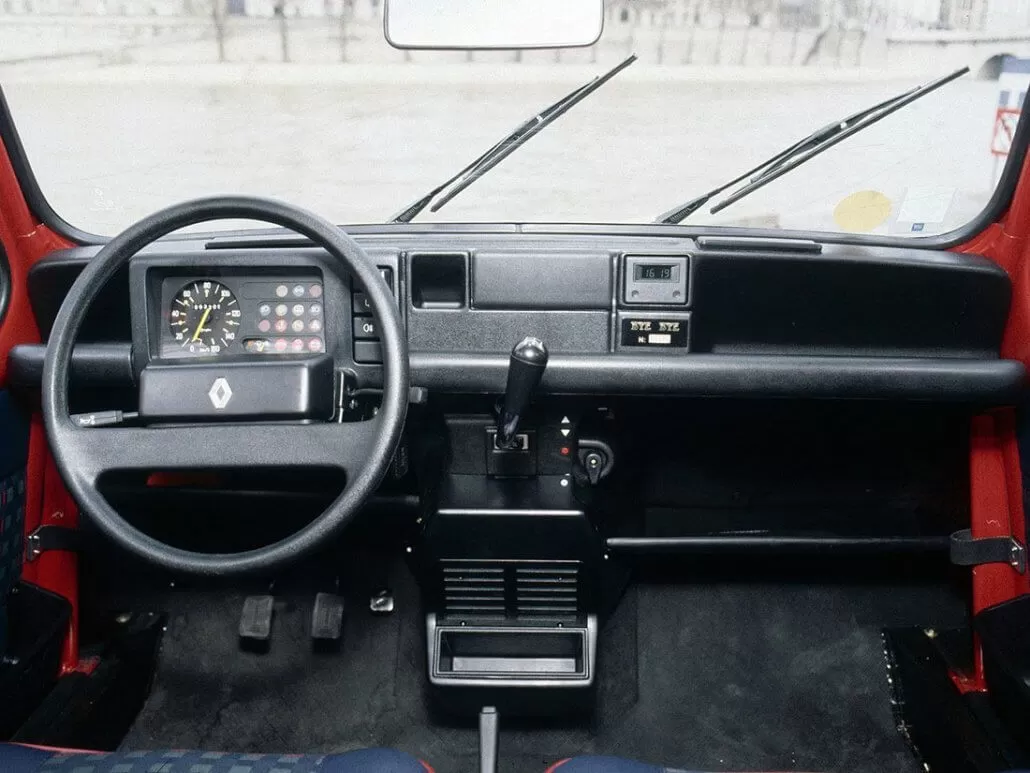
Under the hood, the "Billancourt" engines, offered up to 845 cc and 30 hp, were gradually replaced by the new "Cléon-Fonte" generation starting in 1975 on the van and from 1978 on the R4 GTL.
A commercial career that was accompanied by a film career with its presence in many cult films. In "Trafic" by Jacques Tati in 1971, the 4L transforms into a camper van.
In "Les Sous-doués" in 1980, the 4L SOS Couscous is used to transport the bomb to the embassy. The 4L is found in the middle of the Amazon in "Romancing the Stone" with Michael Douglas in 1984. More recently, in the movie "Nothing to Declare" by Dany Boon in 2010, the 4L of Customs underwent a significant transformation making it capable of outpacing a Ferrari 348. Enzo Ferrari must have turned in his grave.

Like a chameleon, the 4L adapts to its era and multiplies special editions and derivative models to boost sales. It makes its way into upscale neighborhoods as early as 1963, with a large-scale promotion conducted in collaboration with Elle magazine. The event "She takes the wheel" allows 4200 female readers to try for 48 hours R4Ls painted in lacquered color with straw-colored or green or red plaid caning. It seems that a kilt was required to drive the latter. In December of that year, dealerships saw the arrival of the production version. "The Parisian".


The 4 has never wanted to age, always wanting to stay young with vibrant special editions, like the Safari in 1976, which boosted sales and allowed them to surpass 5 million units the following year. We remember the explosive 1981 Jogging version limited to 5,000 units that prominently featured blue, yellow, red, and white. Anne Hidalgo will be delighted to see you participate in the Paris Marathon with her. In the 1980s, the 4L became the car for small budgets and sales began to decline, but it didn't say its last word with a Sixties series limited to 2,200 units available in yellow with red and blue side striping, red with blue and yellow side striping, or blue with yellow and red side striping.


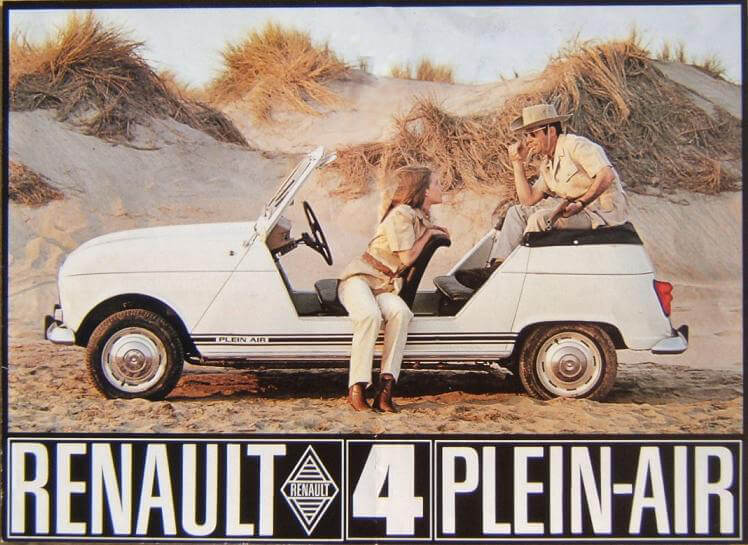
The little one Renault also went on vacation by the beach, or rather in the great outdoors with the rare version "Open-air" manufactured by Sinpar. Riding the wave of beach cars, it quickly drowned with only 563 units produced in 2 years. Sinpar took on the adventurous desires of the 4L - Ah, the youth! - by offering 4x4 conversions throughout its career.
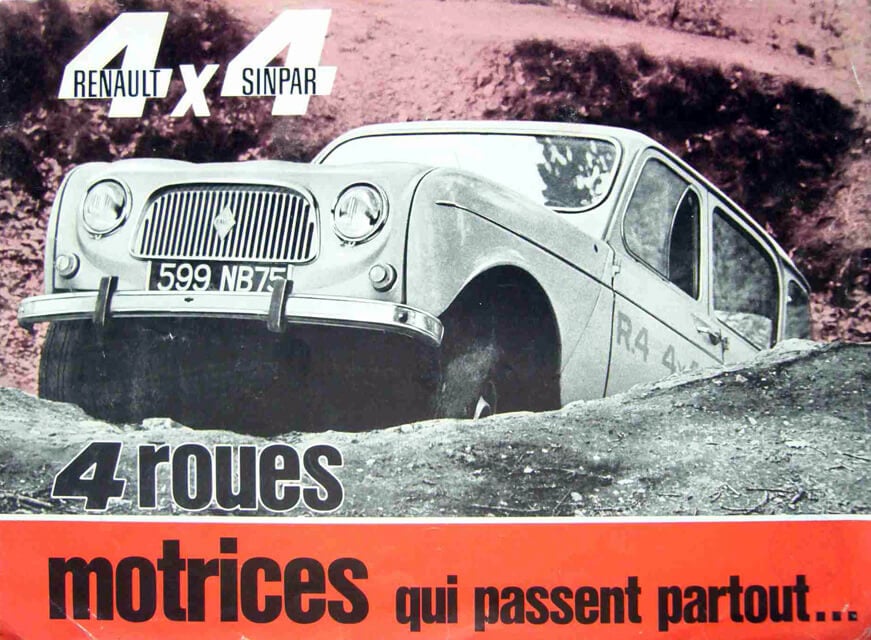
A modification that will allow the 4L to participate in numerous races around the world. The feat of the Marreau brothers who finished 3rd and 5th in the overall ranking of the first edition of the Paris-Dakar Rally in 1979, remains etched in the minds. Certainly, their cars had undergone significant modifications, notably by adopting the engine of the R5 Alpine. This R4 would cross paths with the camels in the next three editions.

The R4 will also bite the dust, with the Formula program. Renault Cross ELF, for 10 years starting from 1974. Up to 60 drivers could gather on the weekends to race on a dirt track with stock 4Ls stripped of their windows, headlights, and bumpers. The event was guaranteed to be entertaining with numerous collisions.

Subsequently, the Phocéenne SMC racing team brought the 4L to life in numerous rallies by building different versions since 1986, with some exceeding 300 hp. It's dangerous to consume too much protein...
Finally, how can we not mention the 4L Trophy. Founded in 1997, it is one of the largest motorized rallies in the world, focused on humanitarian efforts and open to all young people aged 18 to 28.

In 2022, the 4L Trophy celebrates its 25th anniversary. It seems reluctant to age, having postponed the event dates from February to May. This year, nearly 1,400 teams will set off from Biarritz for a 10-day journey through France, Spain, and Morocco. A sporting event that revives the spirit of mutual aid and emphasizes solidarity by delivering school, sports, and medical supplies (30 tons each year), as well as donations to build educational infrastructure for Moroccan children (30 schools already built).
Beautiful values that are dear to us at ALEPOC, and therefore we have supported the crew. "The Aixoises in 4L" composed of Sara and Estelle. We wish them good luck. Go for it, youngsters !

After 31 years of good and loyal service, the The 4L bowed out in 1992. with the last 1,000 units of the Bye Bye series. It is the second most produced French car after the Peugeot 206, with 8,135,424 copies. The 4L is one of the few cars that will remain eternally young. It has accompanied many generations, being the driving school car, the first car after obtaining a license, and continues today to be at the center of young people's discussions with the 4L Trophy. It democratized the automobile and today helps raise awareness among new generations about vintage cars. It is not ready to retire, with its spiritual successor announced for the middle of the decade by the concept. Renault 4Ever. In the meantime, at ALEPOC, we continue to keep the myth alive by offering you a wide selection of spare parts.
Discover our spare parts for Renault R4


