
Shopping Cart
 English
 Français
The Billancourt engine, the little Renault that has stood the test of time

We have already told you about the Cléon-Fonte engine, it's that way. When we talk about an engine Renault, it's the first that comes to mind. Yet, this would be forgetting the one that preceded it under the hood (often rear) of the cars from the company: the Billancourt. And indeed, the latter was produced even longer than the Cléon: 38 years compared to 34 !

The Billancourt engine: the asset of the 4CV
In 1947, the first short story is presented. Renault post-war period. It is the Renault 4CV And for once, it is truly new. Smaller than the previous cars from the brand, more popular, it also features a new engine: the famous Billancourt engine.
It is a 4-cylinder inline engine created by Fernand Picard, the head of engines. Renault during the war. The engine is ready in 1942 and runs on the first prototypes (secret, of course) as early as the following year.
This first version has a displacement of 760 cm³ with a stroke of 80 mm and a bore of 55 mm. One of its features is its gear-driven distribution system, and it is noted for its "older" generation with its three bearings. Its name, like the Cléon engines later on, simply comes from the factory that produces it.
It produces 17 hp SAE, a small amount of horsepower for a small car. But this is only the first version. By 1950, its power increases to 21 hp (still SAE) on the 4CV Grand Luxe, but its production will remain limited.
Permanent evolutions
In 1950, the 760 cm³ engine was replaced. It was succeeded by a 747 cm³ engine with a bore reduced to 54.5 mm. In fact, it foreshadows the first sports version. Indeed, the class of the smallest cars is limited to 750 cm³! This sports derivative would be called the Ventoux engine and would be found in the 4CV 1063 after major modifications. As for the "basic" 747 cm³, it can produce 24 or 35 SAE horsepower.

In 1956, a new car appeared in the range: the Dauphine. If it indeed uses a Billancourt engine, this one has been increased to 845 cm³ with a bore of 58 mm. The power starts at 30 hp but can go much higher since this version will be one of the most produced !
In passing, we note a significant technical evolution as all versions of the Billancourt engine can accommodate thin bearings (the connecting rods being identical).
The following year, the Billancourt engine is found under the hood of the Juvaquatre The station wagon was renamed Dauphinoise. This is a notable change because it is the first time it was mounted at the front of a car from the brand. Two years later, it equipped the legendary Estafette and thus becomes the first engine mounted on a front-wheel drive with a diamond badge !
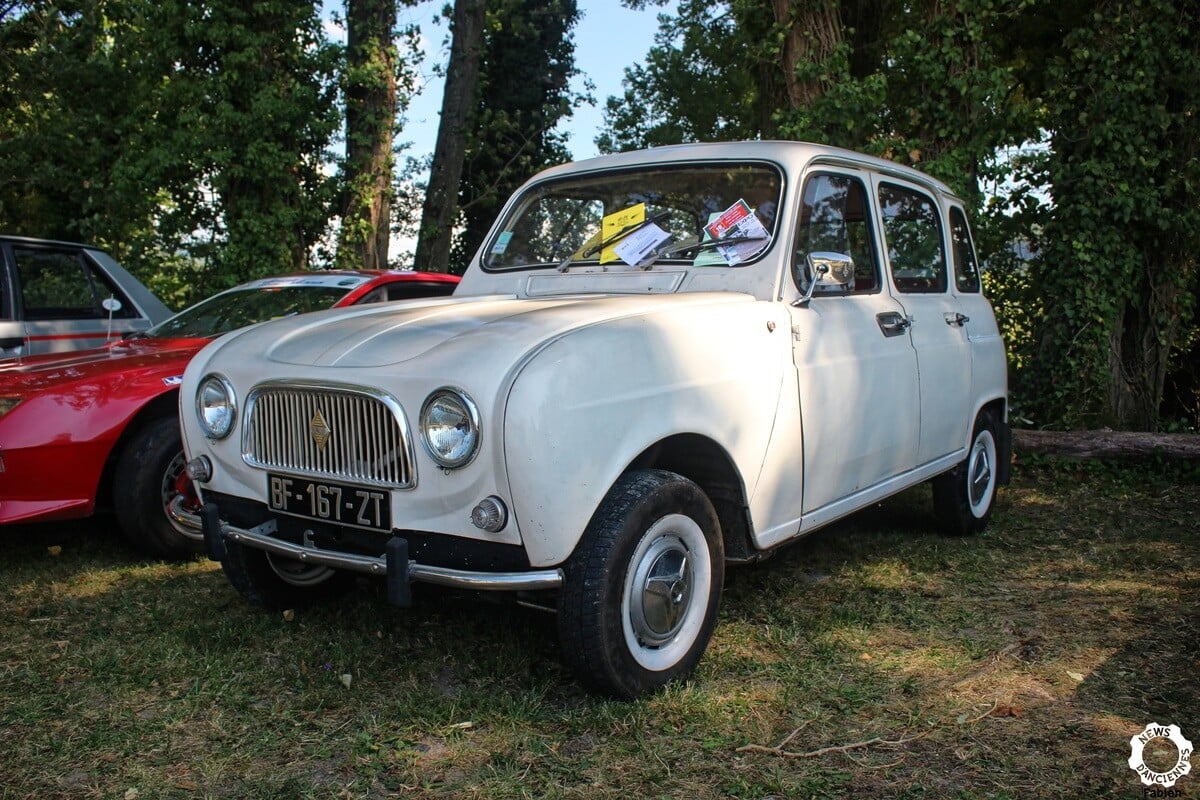
The year 1961 saw the arrival of the Renault 4 which increases it to 845 cm³, also at the front, and also in traction. The confidential Renault The R3, on the other hand, will receive the smallest Billancourt engine ever made: 603 cm³ to remain within the 3 fiscal horsepower category. However, the car will be shunned and production will be halted the following year.

In 1962, the Billancourt engine received reinforcement with the arrival of the Cléon. It replaced it under the hood of the Florida S and it is he who equips the Renault 8.
However, the Billancourt is not shelved. It continues to equip the small Renault.
Thus the Renault 4 and its derivative Renault 6 are equipped with Billancourt. It is only their subsequent evolutions that provide them with Cléon-Fonte. On the other hand, the Renault 8, , 10 and 12 receive cléon. It even evolves in 1965 when the distribution gears are replaced by a more conventional chain.
In 1971, the Billancourt engine was increased to 782 cm³ with a bore of 55.8 mm. It thus equipped the Renault 4 with 27 hp and the following year a 36 hp version is found under the hood of the brand new Renault 5 L. This will be the last version of the engine.

In 1977, the 782 cm³ was replaced under the hood of the Renault 5L by the 845 cm³. In fact, it is this latter version that will remain in production until 1985. The Renault Four adopted the Cléon and the Renault 5 will be the last to board.
You will have understood, the Renault Equipped with the Billancourt engine, there have been many! It is therefore logical that our catalog contains numerous references for the Billancourt engine, regardless of its version. Here are the main models that were equipped with it and the links to find their parts:
Published on
05-02-2021